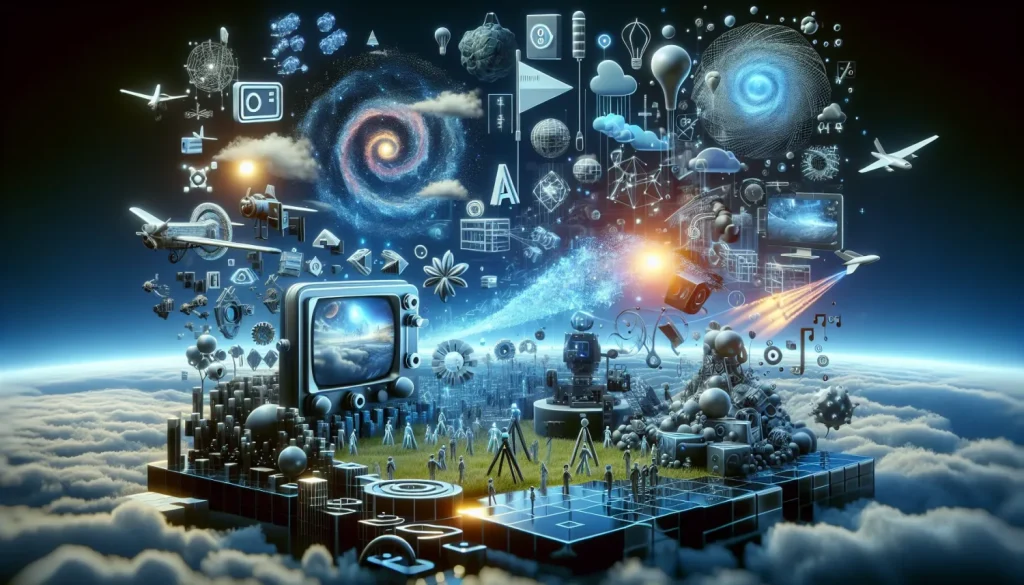
I’ve been watching the rapid evolution of AI with a mix of awe and disbelief. The latest breakthrough I’ve encountered is nothing short of magical – an AI system that can take a single image of the real world and transform it into an interactive 3D scene where you can virtually walk around.
What’s truly remarkable is how this technology understands fundamental properties of our physical world. Water doesn’t just appear as a flat surface – it reflects its surroundings and even simulates realistic fluid dynamics. As someone who spent years studying complex mathematical models to create liquid simulations, seeing an AI system generate this automatically is both humbling and exciting.
But the capabilities don’t stop there. This technology can literally teach cars to fly.
Reimagining Reality from a Single Video
Building on Nvidia’s Cosmos technology, this AI can now use video as input rather than just static images. When given a driving sequence, it demonstrates a deep understanding of the scene. But here’s where things get interesting – researchers can change the camera trajectory in ways that defy reality.
In demonstrations, the AI makes a car fly above the road, continuing to generate a consistent world around it. The system imagines and extends the environment in all directions, showing parts of the scene that weren’t visible in the original footage. The transition between real footage and AI-generated content is seamless – you can’t tell where one ends and the other begins.
This technology enables the creation of countless “what if” scenarios from a single piece of footage:
- What if the car changes lanes?
- What if it takes a different route?
- What if it encounters unexpected obstacles?
These simulations provide safe training environments for self-driving systems before they’re deployed in the real world – a critical step toward safer autonomous vehicles.
Beyond Driving: A Universal World Generator
The applications extend far beyond self-driving cars. When given a selfie of a dog, the AI can show you what’s behind the animal with remarkable realism. The lighting effects are particularly impressive – the system generates accurate reflections, transparency, and even caustics (those beautiful patterns of light that form when light bends through curved surfaces like water or glass).
As someone who researches light transport and ray tracing, I find these results particularly impressive. The AI creates effects that would take human programmers years of study to simulate manually.
The creative possibilities are vast. Filmmakers could extend scenes without expensive reshoots. Game developers could generate expansive worlds from limited reference material. Architects could visualize buildings in different environments without building physical models.
Understanding the Limitations
Despite these incredible capabilities, the technology isn’t perfect. In some examples, the AI makes physical mistakes – like incorrectly rendering animal horns or misunderstanding certain physical properties.
Interestingly, these issues can’t simply be fixed by adding more training data. The fundamental limitation is that these systems are trained to generate footage, not to understand it conceptually. They can create beautiful videos without truly comprehending what they’re doing.
The AI can generate new parts of cities without understanding how a city should function – it only knows roughly what cities look like. The next generation of AI will need to develop a deeper understanding of the world it’s simulating.
The Future is Arriving Faster Than We Imagined
The pace of progress in AI research is breathtaking. Today’s point cloud representations can already be converted to full 3D geometry. While current limitations exist – resolution could be higher, and some generated content still looks slightly off – these issues will likely be resolved soon.
What excites me most is that this research isn’t locked behind closed doors. The full papers are available, and the source code will be freely accessible to everyone. This open approach accelerates innovation and democratizes access to cutting-edge technology.
I believe we’re witnessing just the beginning of AI’s creative potential. The ability to generate and manipulate realistic 3D worlds from minimal input will transform industries from entertainment to education, from architecture to urban planning. And unlike the speculative discussions about AI that dominate headlines, these are real, demonstrable capabilities backed by solid research.
The future of AI isn’t just about automation – it’s about augmenting human creativity in ways we’re only beginning to imagine. And that future is arriving faster than anyone predicted.
Frequently Asked Questions
Q: How does this AI technology differ from traditional computer graphics?
Traditional computer graphics require explicit programming of physical laws, material properties, and lighting models. This AI approach learns these properties from data, generating realistic visuals without requiring programmers to code each physical interaction. It can also extrapolate and imagine unseen parts of a scene, which traditional graphics cannot do without additional input.
Q: What are the practical applications for this technology beyond self-driving cars?
This technology has numerous applications across industries. Film and game studios could use it to extend environments without expensive production. Urban planners could visualize city changes before implementation. Virtual reality developers could create immersive worlds from limited reference material. Educational platforms could generate interactive simulations for complex concepts.
Q: Why can’t the AI’s understanding of physics be improved simply by adding more training data?
The current limitation isn’t just about data quantity but about how these systems are designed. They’re optimized to generate visually convincing content rather than to understand physical principles. Creating AI that truly comprehends physics requires different architectural approaches that incorporate physical reasoning, not just pattern recognition from visual data.
Q: How will this technology impact creative professionals like artists and designers?
Rather than replacing creative professionals, this technology will likely become a powerful tool in their arsenal. Artists and designers could quickly generate multiple variations of environments, test different lighting conditions, or visualize concepts without laborious manual work. The technology handles technical aspects of creation, allowing humans to focus on creative direction and conceptual decisions.